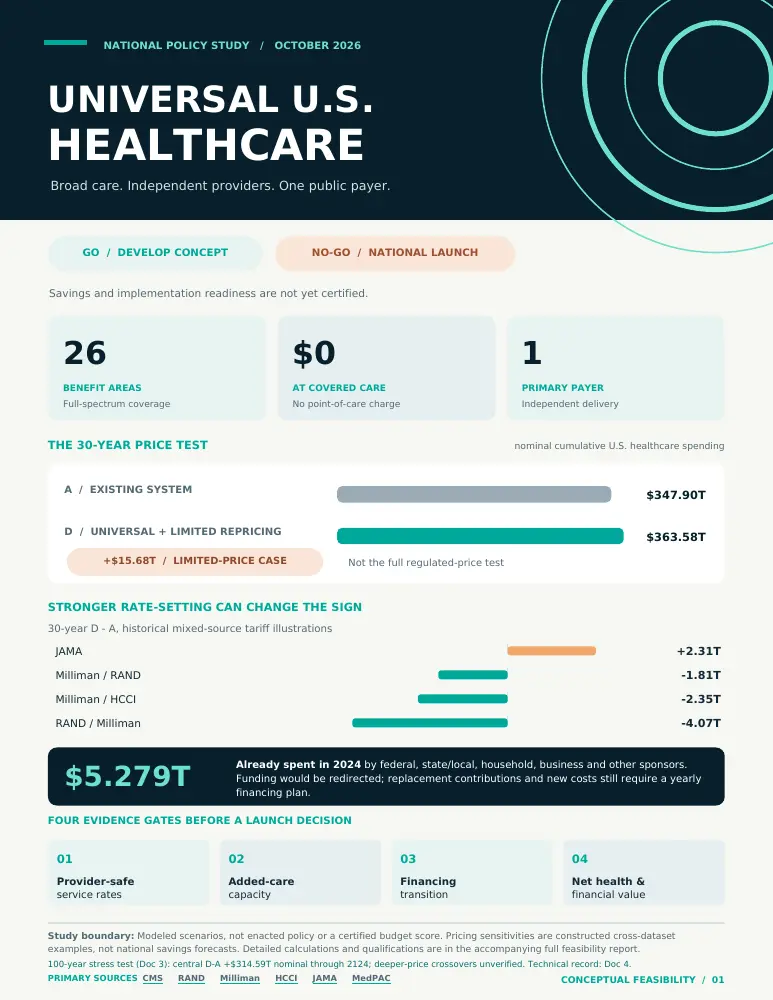
01 · Start here
Executive Policy Brief
The essential one-page orientation: proposed changes, central results, and the evidence required before policy action.
Could nationwide healthcare coverage work with independent providers and regulated payments? Explore the policy design, its financial tests, and the questions still unresolved—in four openly available research documents.
View any PDF in your browser or download an identical copy for offline analysis.
The essential one-page orientation: proposed changes, central results, and the evidence required before policy action.
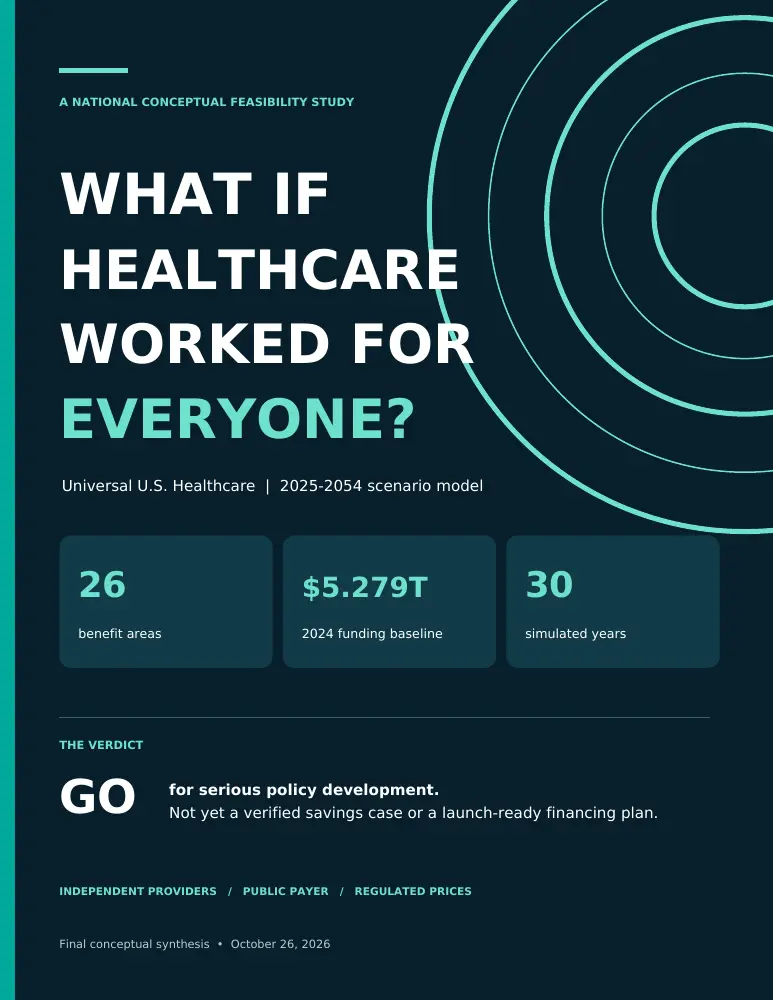
The 30-year scenario study: coverage rules, benefit areas, provider capacity, financing, and operational constraints.
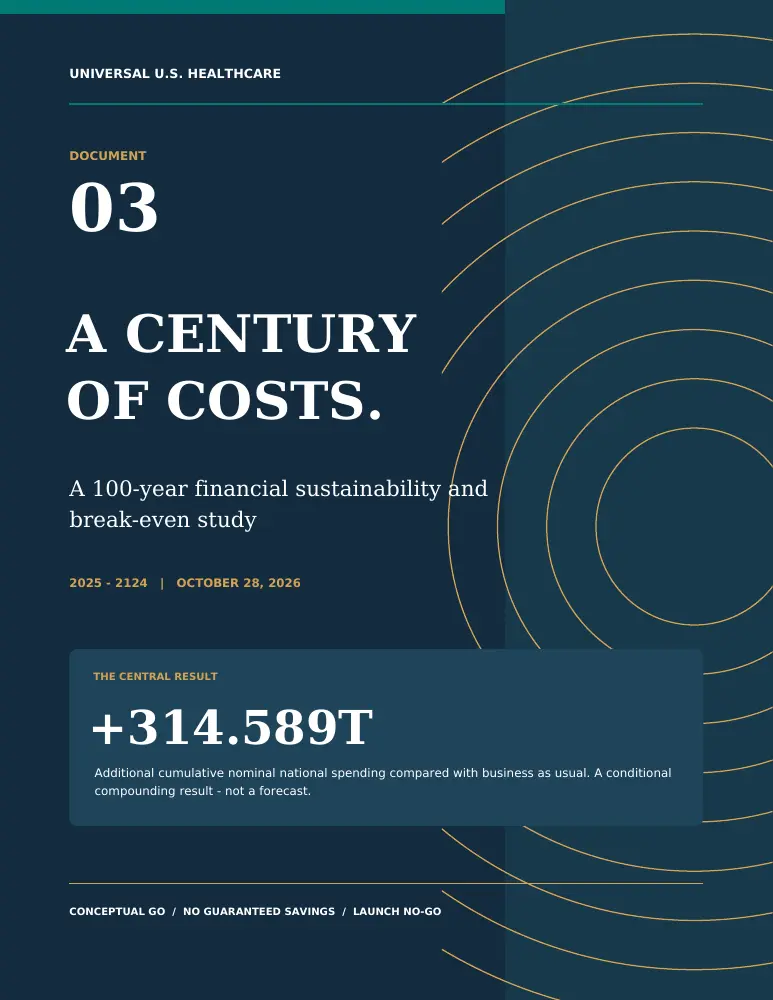
Extends the central comparison to 2124, separating conditional lower-cost cases from established results.
The full technical record: methods, ledgers, citations, limitations, corrections, and historical context.
Four documents, one proposal, four levels of examination. Open a card to see what each document covers.
The documents increase in depth. Start with the one-page brief for the central findings, then follow the question you want to investigate: policy design (2), long-run spending (3), or evidence and methodology (4). You can read them individually or in order.
A quick orientation to the proposed system, the central cost comparison, and the four evidence gates before launch could be considered.
Best for: Everyone, especially elected officials and time-constrained decision-makers.
The accessible 30-year study of the coverage design, 26 benefit areas, financing assumptions, provider capacity, and four comparison scenarios.
Best for: Policy staff, health professionals, and readers assessing overall feasibility.
Extends the 30-year results through 2124 under explicit assumptions to test long-run spending and potential break-even points.
Best for: Budget analysts, economists, and readers focused on long-term affordability.
The detailed technical record with assumptions, expenditure ledgers, source references, research limitations, corrections, and the preserved historical record.
Best for: Researchers, economists, legislative analysts, and independent technical reviewers.
The study compares coverage and payment rules under four scenarios:
D minus A is the principal spending comparison. A positive value means higher modeled national healthcare spending than business as usual; a negative value means lower modeled spending. These are all-payer national totals, not estimates of additional federal borrowing.
Central result: Scenario D is modeled at approximately $15.68 trillion more over 30 years and $314.589 trillion more over 100 years than Scenario A. More aggressive price-setting examples can reverse the arithmetic, but their provider reimbursement assumptions and real-world feasibility are not validated. This work warrants independent testing, not an immediate national launch.
We welcome substantive criticism, alternative evidence, and referrals to qualified reviewers.
This is a research proposition, not a ready-to-enact plan. Four evidence gates need defensible answers before implementation could responsibly be considered:
Can reimbursement meet actual service-delivery costs while keeping practices viable?
Can the workforce, facilities, and appointment supply serve the additional patients?
What must be funded, by whom, and when—especially during the transition?
Will patient outcomes and total system performance improve under observed conditions?
We are seeking concrete critiques, source corrections, and independent technical review—not an endorsement.
darkstar@darkstarconsultinggroup.com